Thursday Thoughts: Vibe Coding Tools Are Starting a Price War, and Airlines Tell Us This Doesn’t End Well
A few of us at Coder were going back and forth in Slack recently, starting with Daniel dropping the news that Lovable had just raised at a $13.3 billion valuation. Eighteen more replies of ARR, token reselling, and margin structures followed.
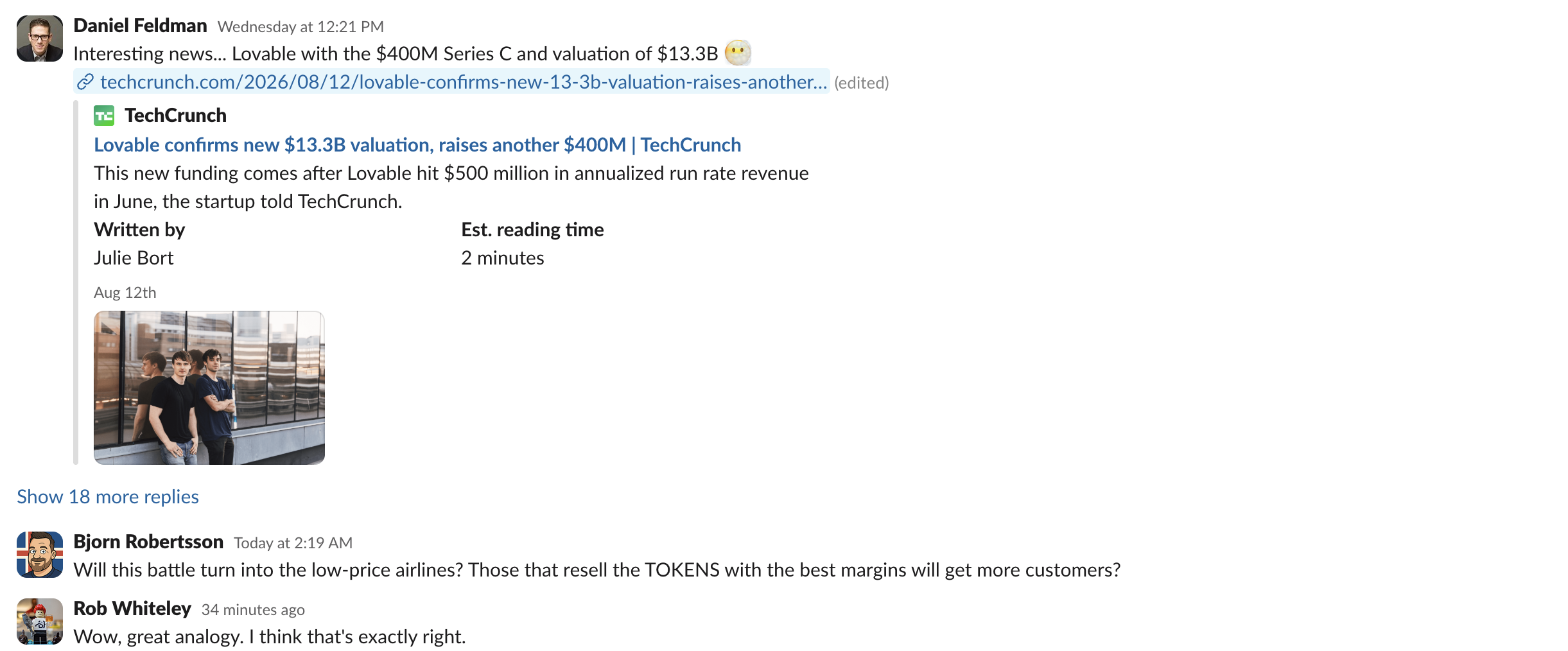
Then today, Bjorn made a sharp analogy. This whole market reminds him of the airline price wars.
Yes, yes it does. Let’s explore.
The Race to the Bottom Is Already Underway
The low-cost airline model was never really about flying. It was about winning specific routes, locking up specific regions, and undercutting everyone else on price until the competition gave up or ran out of cash. That’s exactly what’s happening in AI coding tools right now.
Every player is scrambling to offer the cheapest possible token. Resell a frontier model at razor-thin margin. Host open-weight models yourself. Post-train your own model to cut costs further. There are a dozen different strategies, but they all point in the same direction. Down. Meanwhile the valuations are going the opposite direction: Lovable’s ARR has nearly tripled and is tracking toward $600 million by the end of August, and it’s competing directly with Replit’s $9 billion valuation from March. That’s not a market with one obvious winner yet. That’s a market with several very well-funded companies all racing for the same seat.
It’s also a war of attrition dressed up as innovation.
Where This Playbook Actually Comes From
Bjorn’s comparison wasn’t a throwaway line. It’s a documented, fifty-year pattern, and it’s worth walking through because the shape of it is exactly the shape I see forming in vibe coding tools today.
It started with one airline finding a regulatory loophole. Before 1978, the Civil Aeronautics Board regulated US airlines like a public utility, setting where they could fly and what they could charge, which kept fares high and competition low. Southwest Airlines got around that entirely by staying inside Texas: because intrastate flights were exempt from CAB regulation, Southwest could offer cheap fares between Dallas, Houston, and San Antonio starting in 1971 while Braniff and Continental, bound by CAB pricing, couldn’t legally match it. Rivals sued, calling it unfair competition. They lost.
Then the government made that loophole the law for everyone. On October 24, 1978, President Carter signed the Airline Deregulation Act, dissolving the CAB and letting every airline set its own routes and fares. Southwest’s Texas-only trick became the entire industry’s new operating model overnight, and base ticket prices have declined steadily ever since.
The first casualties were the legacy carriers, not the upstarts. Without the CAB’s guaranteed rate of return, storied names like Pan Am, Eastern Air Lines, and Braniff International couldn’t compete in the new world of open markets. That’s the part of the story people forget: deregulation didn’t just create Southwest, it killed the incumbents that couldn’t reprice fast enough.
Then it happened again in Europe, on a longer fuse. European market liberalization in the 1990s created the same conditions for low-cost carriers to thrive, and Ryanair (1991) and easyJet (1995) ran the Southwest playbook a continent over. By the mid-2010s, low-cost carriers controlled about 40 percent of scheduled European services that barely existed twenty years earlier.
And then the second wave of casualties arrived — this time, the low-cost carriers themselves. Growth at any cost eventually meets a market that can’t support every entrant at once. Since 2017 alone, European budget-airline closures have included Air Berlin, Monarch, WOW Air, Germania, Flybmi, Primera Air, and Small Planet Airlines. Monarch’s ending is the cleanest case study: it lost £291 million in a single year with a 78 percent load factor against Ryanair’s 97 percent, and when it collapsed, survivors didn’t buy the company, they just cherry-picked its assets — planes, landing slots, staff — and moved on.
The Frontier Labs Are the Legacy Carriers Except This Time They Also Own the Fuel
Here’s where the analogy gets sharp. Count how many of the airlines that fought the original price war are still flying independently. Not many. Some got absorbed. Some collapsed outright. The survivors either found a niche with enough pricing power to sustain themselves, or they got swallowed by a bigger carrier who wanted their routes and their customer base.
That’s the map I see for vibe coding tools. A small number will get acquired, because their user base is real and their brand has some stickiness. The frontier labs, the ones who own the underlying models, are the legacy carriers here, and I’ve made this exact comparison before with Anthropic and AWS: they built the ecosystem, and now they’re positioned to eat pieces of it. They have the infrastructure, the capital, and the distribution. Acquiring a scrappy tool with a few million loyal users is cheaper than building that audience from scratch. Meta, notably, is trying the harder path instead of the easier one, fighting head-on with Muse instead of owning the sovereign-AI lane its open weights already won it — its own version of a carrier picking the wrong route to compete on.
The rest will die on the vine. Not in a dramatic crash, but in the slow, quiet way that companies do when growth stalls and investors stop picking up the phone. Except when it isn’t slow at all: Spirit Airlines, once the largest ultra-low-cost carrier in North America, filed for Chapter 11 twice in nine months and then, on May 2, 2026, simply stopped flying — no wind-down grace period, no more flights the next morning, seventeen thousand jobs gone. Regulators had actually tried to prevent this outcome. In 2024, a federal judge blocked Spirit’s merger with JetBlue on antitrust grounds, reasoning that combining two low-cost carriers would reduce competition and raise fares for consumers. Two years later, Spirit is gone entirely and there’s one fewer low-cost option in the market the ruling was meant to protect. Sometimes preventing the merger just moves the same consolidation from a boardroom to a bankruptcy court.
A Soft Winter Not a Bubble Burst
I want to be careful here. I’m not calling a bubble. The underlying technology is real, the demand is real, and enterprise AI adoption is still accelerating — I’ve written before about vibe coding’s move into the enterprise. But there’s a difference between a market being real and every company in that market surviving.
When you combine races to the bottom with the current political headwinds around data centers, and you look at how breakneck the investment pace has been, it’s hard to argue that we’re not heading for a soft winter. I expect the funding environment to cool noticeably this fall. Not a freeze. A slowdown. The kind where only the companies with genuine differentiation keep raising at sensible valuations — really just the gut-check question every startup founder should already be asking: does your business get better as the underlying models improve, or does it get commoditized right along with the token price?
The question isn’t whether this shakeout happens. It’s how fast, and airlines have now answered that twice: a regulatory or technical unlock, a burst of new entrants, a brutal price war, and a consolidation where a handful of winners absorb the survivors while the rest disappear — sometimes with a warning, sometimes overnight, the way Spirit’s fall from largest ULCC in North America to fully liquidated took about eighteen months once the debt outran the fare wars.
If you’re building one of these tools, which side of that line do you think you’re on?
By the Numbers
- 1971 — Southwest Airlines begins flying intrastate-only routes in Texas to dodge federal fare regulation
- October 24, 1978 — the Airline Deregulation Act opens every US route and fare to open competition
- 40% — share of scheduled European flights controlled by low-cost carriers that barely existed twenty years earlier
- 7+ — European budget airlines that have shut down since 2017, including Air Berlin, Monarch, and WOW Air
- 2 — Chapter 11 filings by Spirit Airlines in less than a year before it stopped flying entirely
- 17,000 — jobs eliminated when Spirit ceased operations on May 2, 2026
- $13.3 billion — Lovable’s valuation after doubling in eight months
- $9 billion — Replit’s valuation as of its March 2026 round, the closest direct comparable